Stream Cleanup Event

Saturday, October 25, 2025 8:30 – noon

City of Harrisonville, Street Department
1403 S Independence St
Harrisonville, MO

Make a difference in you watershed!
Join us for the 6th Annual Stream Cleanup in Harrisonville.
Learn about healthy waterways and help remove trash and debris from Town Creek & Muddy Creek. 

Schedule:
8:30 – Registration

9:00 – Stream Monitoring Demonstration, watershed information and Safety Talk

11:30 – Hot dog lunch provided by Cass County Elks Lodge No. 2791

Provided: Safety Training, gloves, collection bags

What to bring:  Reusable bottle of water.  Wear appropriate clothing and shoes.

This event is sponsored by:
City of Harrisonville Public Works Division and Parks and Recreation
South Grand River Watershed Alliance (SGRWA)
Missouri Stream Teams

11th Annual Belton Stream/Watershed Event

11th Annual Belton Stream/Watershed Event

Wallace Park, Belton, Mo.

Saturday, March 29, 2025

Parking available at
High Blue Wellness Center

 16400 N. Mullen Road and 16500 Cornerstone Drive

Join your friends, neighbors, scouts, city officials, and others in learning about and caring for the stream/watershed in your Belton community.

Schedule:

8:30:   Register at information tent south of Soccer Fields off Mullen Road           

            Coffee and donuts

9:00:   Watershed information/Safety talk

              Stream monitoring demonstration by SGRWA:  learn about                                       macroinvertebrates and what they tell us about water quality.

9:45:  Pick up trash

11:30: Hot dogs and socializing

What to Bring:

Your own reusable bottle of water. Wear appropriate clothing and shoes.

Provided:  Safety training,  gloves, trash bags

SPONSORED BY

South Grand River Watershed Alliance          www.sgrwa.org

Belton Parks & Recreation               (816) 642-6510

Contribute to a Healthier Watershed

  • Pick up trash wherever you find it — your neighborhood, on trails, at the park, etc.
  • Plant Missouri Native plants in your landscape
  • Remove invasive plants from your yard
  • Reduce your plastic consumption
    • Say No! to single use plastics
    • Use non-plastic reusable containers for drinks and food
    • Bring your own bags to the grocery store
  • Participate in Stream Cleanup events
  • Volunteer to help SGRWA with projects & to get the word out

GET OUTSIDE and ENJOY NATURE – you may be amazed and inspired by what you see


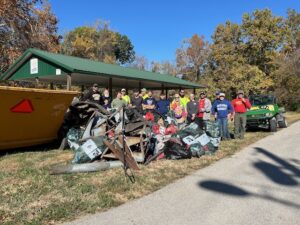
Town Creek at Lord’s Park October 26, 2024

The South Grand River Watershed Alliance (SGRWA) and Harrisonville Public Works partnered
to host a stream cleanup along Town Creek Saturday morning, October 26. A group of
enthusiastic, dedicated volunteers, which included residents of Harrisonville, Lee's Summit, and
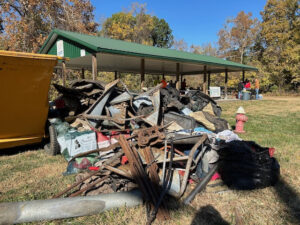
Pleasant Hill, gathered at Lord's Park and picked up an amazing amount of trash that included a
large amount of scrap metal. The group separated the scrap metal from the other trash for
recycling.
Information was presented to the group about the importance of keeping trash out of the
stream and its corridor and learned of other significant actions we can each take to improve the
health of the watershed and its tributaries. The information included the role native Missouri
prairie plants have in reducing runoff and flooding, providing essential habitat for native
butterflies, bees, and other pollinators and other wildlife, including birds. They also received
information about the importance of practicing the three "Rs": Reducing the amount of trash
generated, buying products for Reuse rather than one-time use that all too frequently involves
a pitch out of a car window instead of proper disposal, and Recycling items that are recyclable.
Volunteers were appreciative of the breakfast items provided by Harrisonville Public Works and
of the hot dog lunch prepared by the Cass County Elks.
Be sure to watch for this annual event and plan to participate in the fall of 2025!
Photo: Volunteers pose in Lord's Park with the bags of trash and scrap metal (later recycled)
collected at the annual fall Stream Cleanup Event

November 2nd Stream Cleanup

An area along Belton's Cleveland Ave and Cambridge Road became healthier and more inviting
for wildlife and people Saturday, November 2 at the fall Stream Cleanup hosted by the South
Grand River Watershed Alliance and Belton Parks and Recreation.
Volunteers enjoyed light breakfast treats provided by Belton Parks and Recreation before being
informed about safety as well as the importance of caring for the watershed and its tributaries.
Information was provided to inform of actions each of us can take to improve the health of the
watershed that included planting native prairie plants in landscaping to slow and absorb runoff
to diminish flooding and to provide essential habitat for native butterflies, bees and other
pollinators as well as for birds and other wildlife. Information was also provided about the
importance of practicing the three Rs to improve watershed health: Reduce the amount of
trash generated, buy products that can be Reused, and Recycle items that are recyclable and
properly dispose of items that can't be reused or recycled.
The hot dog lunch prepared and served by the Belton Lions Club was very much appreciated by
the volunteers at the end of the morning.
Be sure to watch for future stream cleanups and make plans to participate.

Your Water Quality and Macroinvertebrates

Your Water Quality and Macroinvertebrates

Ted Lange

   The South Grand River Watershed

     A watershed is only as good as the water that flows through it, and everything in the watershed affects the quality of that water. The species, numbers, and diversity of plants agricultural land, impervious cover of highways, parking lots, buildings, industrial discharges into streams etc., all have an effect —good or bad—on the quality of water in streams. We can learn much about the quality of water in a stream from the macroinvertebrates (tiny aquatic animals without a vertebrae) living in the water because they are indicators of water quality. Volunteer groups often do the work of gathering the information these aquatic animals can provide. This article is a brief broad overview of how water quality is diminished; how aquatic animals tell us the status of water quality; and who participates in the work to collect the data.

     Every watershed has a beginning and an end. The Missouri Department of Conservation (MDC) has divided Missouri into 20 watershed Units. Within each unit are multiple watersheds—all flowing to a common destination.  The South Grand River Watershed is in the north portion of Unit 11 and flows from near Belton in Cass County to its end in Truman Lake. The South Grand River Watershed Alliance (SGRWA) is one of 22 Associations, the only one in Unit 11, with some of the 20 Missouri Units having multiple Associations and about five having no Associations.

     According to MDC, many streams in the South Grand River Watershed (SGRW) suffer from water quality problems. A contributing factor could be that the South Grand River (SGR) is mostly supplied by runoff from rain. There are very few other sources such as springs or ice melts contributing water to the South Grand River.

     There are 13 cities with a population of 1,000 or more in the SGRW.  These cities are a consistent year-round source of water to the SGR since they discharge their treated waste water into streams of the watershed that feed the SGR as well as into the South Grand River itself. This may sound gross, but it is a source that contributes to keeping the water moving and the treated waters are tested and controlled so that water is actually clean. In addition to the treated water discharged from sewer plants into streams, runoff from hard surfaces (streets, parking lots, rooftops, etc. is channeled directly into smaller streams feeding the SGR and into the SGR.  This runoff enters streams via storm sewers that pipe the runoff, untreated, directly to streams.

   Earlier in Cass County’s history, the activities associated with coal mining were a significant source of contamination in several streams of the SGRW. While these sites have mostly been cleaned up, several streams in the SGRW are on the impaired list due to the continuing impacts of those coal mining activities.  While other SGRW streams are impacted by activities such as stream channelization and runoff containing sediment and contaminants from agricultural activities, the sources most of us are in contact with are the contaminants such as road salts, oil, lawn fertilizers, pesticides, etc. that are washed, with no treatment, down the storm drain directly to the waters of the watershed.

   Of course, as the old saying goes, ‘the best solution for pollution is dilution’ still fits—but that doesn’t mean it isn’t there. This area receives an average of about 40″ of precipitation per year, and rains do flush out the river quite often during the year.  These diluted pollutants are reduced to tolerable levels and flow on downstream for further dilution.

What aquatic animals (macroinvertebrates) tell us about water quality


     Aquatic macroinvertebrates are animals without a backbone that live in the water.  Many are the larval stage of some insects such as dragonflies, mayflies, stone flies, etc that spend that stage in a small area of a stream or snails, crayfish, worms and others that move only short distances from where they live—sand, gravel, rocks are the first things that come to mind in a stream, but leaves, twigs, and muck are more commonly found in the SGR. Spending their entire lives in a very small area makes them sensitive to pollutants in the stream water.  Some are intolerant of any pollutants, while some species are able to tolerate some pollution and others can tolerate very polluted waters. This fact makes them highly valued in assessing the degree of pollution within the stream area they live. For example, finding only macroinvertebrates tolerant of polluted water such as black fly larvae, leaches, and others but no pollution intolerant species such as caddisfly or mayfly larvae reveals a lot about the level of pollution in that particular area of a stream.

     To collect macroinvertebrates the first step is to dislodge some from their microhabitat with the most common process being to locate a riffle (shallow moving water) and set up a collection net downstream.  Next kick or shallowly dig (3- 6 inches) into the stream bed to move the macroinvertebrates from their microhabitats. After they are collected in the net, they can be taken to shore, separated according to species, identified and counted. Macroinvertebrates are very small but easily identified with an identification chart featuring a key under each photo or drawing.  *see resource

     The counting and compiling of the numbers give an EPT* index of pollution tolerance.  While the EDT index number is an indication of water quality, it does not provide the reason for that level of water quality. Physical and chemical testing are required to obtain enough information to determine what is actually in the water.

     Why does all this matter?  By learning about the health of our watershed and components of a healthy watershed with quality water in its streams we can each become aware of our own actions and make decisions in our own lives and for our community to improve the health of our watershed and of our lives.

*EPT:  Pollution intolerant species (Ephemeroptera (mayflies), Plecopters (stoneflies), and Trichoptera (caddisflies)

Note:  See opportunities to participate in two stream cleanup events (October 26 and November 2) each includes a stream monitoring demonstration.

For information on becoming a member of Missouri Stream Team and learning how to monitor streams:https://mostreamteam.org

Resource:  Missouri Stream Team Guide to Aquatic Macroinvertebrates (includes information on materials needed and how to do a stream sample:https://mostreamteam.org/assets/missouristreamteamguidetoaquaticmacroinverts.pdf
Image

Latest News

Plastic pollution has significant negative impacts on the health and beauty of our streams and watersheds

Here are some facts about plastics:

  • 99% of plastics is produced from fossil fuels and does not readily biodegrade.
  • It is estimated 18 million metric tons of plastic waste enters the world’s oceans each year.
    • Think of 1 garbage truck of plastic being dumped every minute!
  • 42% of all plastics produced is single use.
  • Plastic waste is the least recycled and recyclable of all persistent solid waste.
  • More than half of all plastic that has ever existed was produced in just the last 15 years.
  • Global plastic production is expected to double by 2040. Interactive Graph
  • EPA has estimated plastic waste accounts for 18.46% of all material by weight taken to landfills (2018 estimates)
  • Very little plastic is actually recycled or even recyclable.  We CANNOT recycle our way out of this problem.

Make a Difference in your watershed

  • Start using reusables for drinks and food.
  • Bring your own bag to the grocery store or anywhere you shop.
  • Pass on the straws

Get involved

Learn More